Guide · Breathing
Do nasal strips help with running and workouts?
Quick answer
External nasal strips reliably reduce nasal airway resistance, which makes breathing through the nose easier, and they can delay the switch to mouth breathing during exercise. But a 2020 systematic review of 19 studies found no significant effect on VO2max, heart rate or perceived exertion. Use them for comfort in nasal breathing, not as a performance enhancer.
- The FDA classes external nasal dilators as Class I devices that decrease airway resistance and increase nasal airflow.
- Strips lower nasal resistance; the effect is larger in people with more nasal resistance to begin with.
- Performance results are mixed: one meta-analysis found no effect, another found small effects with very low certainty.
- Nasal strips are not intended to treat snoring or sleep apnea.
How nasal strips work
An external nasal strip has a flexible band inside an adhesive strip. Placed across the nose just above the nostrils, the band tries to straighten and lifts the side walls of the nose outward. That widens the narrowest part of the nasal airway, the nasal valve, without putting anything inside the nose.
In US regulation, external nasal dilators are Class I medical devices under 21 CFR 874.3900, described as devices that decrease airway resistance and increase nasal airflow.[5]
What happens to breathing during exercise
At rest most people breathe through the nose. As effort rises, they switch to mouth or combined breathing because the nose cannot move enough air. Studies show strips reduce nasal resistance and the work of nasal breathing during exercise.[3] In one study (9 participants) they cut resting nasal resistance by about a third and delayed the switch to mouth breathing by around 15%, an effect the authors called relatively small.[4] Not everyone responds: in one study 11 of 15 participants did.[3]
Do they improve performance?
Here the evidence is mixed. A 2020 systematic review of 19 studies found strips did not significantly change VO2max, heart rate or perceived exertion.[1] A 2022 meta-analysis of 11 running studies found small differences favoring the strip over a placebo strip for VO2max and perceived exertion, but rated the certainty of that evidence as very low.[2]
The honest summary: strips make nasal breathing easier for many people, which feels better, especially in easy and moderate training. Don't expect them to make you faster.
Using strips in training and races
- Try them in training first, not on race day.
- Apply to a clean, dry, oil-free nose, before sunscreen.
- Choose a size that sits flat; a band that is too long lifts at the ends.
- Remove slowly with warm water. Do not reuse.
Are nasal strips allowed in races?
Generally yes. External nasal strips are drug-free and work mechanically, and anti-doping rules list prohibited substances and methods rather than equipment like this. Equipment rules are set by each event, so check your race's athlete guide, and test strips in training rather than on race day.
Not for snoring or sleep apnea
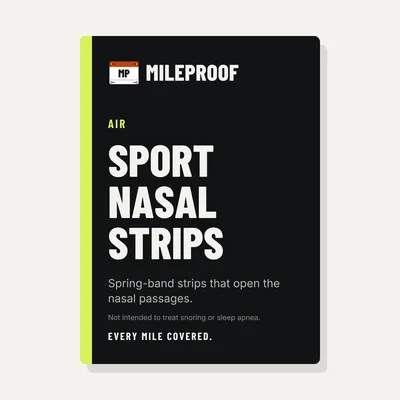
MILEPROOF Sport Nasal Strips are designed for use during exercise. They are not intended to treat snoring or sleep apnea. Loud regular snoring, pauses in breathing during sleep or heavy daytime sleepiness are reasons to see a doctor.
FAQ
Do pro athletes use nasal strips?
Some do, in football, running, cycling and fitness racing. That shows athletes find them comfortable; it isn't evidence they improve performance.
Are nasal strips good for working out?
Many people find nose breathing more comfortable with a strip during easy and moderate workouts. Research doesn't show a consistent effect on performance, so judge them by comfort.
Are nasal strips safe?
They are low-risk Class I devices. Do not use them on sunburned, irritated or broken skin, and stop if the skin reacts.
Sources
- Does the external nasal dilator strip help in sports activity? A systematic review and meta-analysis. Dinardi et al., European Archives of Oto-Rhino-Laryngology, 2020.
- Nasal dilator and physiological parameters associated to running performance. Gomes et al., Journal of Sports Sciences, 2022.
- Nasal resistance and flow resistive work of nasal breathing during exercise: effects of a nasal dilator strip. Gehring et al., Journal of Applied Physiology, 2000.
- Nasal dilator strips delay the onset of oral route breathing during exercise. Seto-Poon et al., Canadian Journal of Applied Physiology, 1999.
- 21 CFR 874.3900 Nasal dilator. US Code of Federal Regulations (eCFR).